
Introduction to Orbital Mechanics Preview
In the ancient civilization era, early scientists studied the universe beyond the Earth’s atmosphere and the movements of the Sun, Moon, planets, comets, and asteroids. During the era, early agricultural practices and the desire to better understand the timing systems, the arrival of each growing season led to the development of the early calendars, such as the Gregorian calendar.
In the sixteenth century, the ancient Greek philosophers’ ideas shaped the worldview of Western Civilization, which led to the Scientific Revolution. During the period, some philosophers believed that planets orbited around the Sun. Aristotle, in his submission and conclusion, believed that the planets and the Sun orbited Earth and that the Earth had to be stationary, and the planets, the Sun, and the fixed dome of stars rotated around the Earth, leading to geocentrism that dominated natural philosophy for almost 1,000 years.
In the year 1515, Nicolaus Copernicus proposed the idea that the Earth was a planet like Venus or Saturn, and that all planets circled the Sun, referred to as heliocentrism. Evidence for the validity of Copernicus’s heliocentric theory was put forward by Galileo when he observed four moons in orbit around Jupiter, and around January 7, 1610, he mapped nightly the position of the 4 “Medicean stars”.
Various contributions from different philosophers and scientists, such as Ptolemy, Tycho Brahe, Copernicus, Galileo, Kepler, Newton, and a host of others, over many years, led to the evolution of orbital mechanics and emphasized its importance. Some of the applications of orbital mechanics are Mission Planning, Interplanetary Missions, Global Navigation Systems, Space Debris Mitigation, Satellite Deployment and Control, etc.
Orbital mechanics is essential for planning trajectories of spacecraft traveling to other planets, calculating launch windows, orbital transfers (like Hohmann transfers), and gravity assist maneuvers for reaching distant planets and entering their orbits.
Mission planners use orbital mechanics to determine optimal launch times, trajectories, and orbital insertion points for spacecraft. This ensures the successful arrival at the target planet and efficient use of fuel.
Orbital mechanics provides the framework for navigating spacecraft during their missions. Similarly, by monitoring a spacecraft’s position and velocity, controllers can make spacecraft adjustments to stay on course. It helps in timing systems analysis, reference frames analysis and transformation, the Two-Body problem, and Trajectory equation development.
This course is aimed at providing information on evolution of orbital mechanics, Timing Systems, Reference Frames & Coordinate Systems, The Conic Sections, The Two-Body Problem, Fundamental Integrals, Trajectory Equation, and Applications of Orbital Mechanics in such a way that university students, space enthusiasts, space professionals, and interested individuals will have a better understanding of the orbital mechanics concept and its various applications to space exploration. Example questions and exercises are provided for better understanding.
In addition, the course is divided into nine modules: Module 1, Module 2, Module 3, Module 4, Module 5, Module 6, Module 7, Module 8, and Module 9.
a) Module 1: Evolution of Orbital Mechanics:
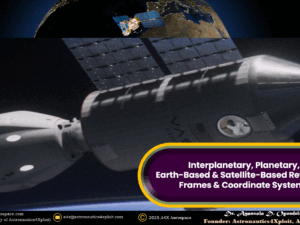
b) Module 2: Timing Systems, Reference Frames & Coordinate Systems:
c) Module 3: The Conic Section:
d) Module 4: The Two-Body Problem:
e) Module 5: Fundamental Integrals:
f) Module 6: Trajectory Equation:
g) Module 7: Applications of Orbital Mechanics:
h) Module 8: Example Questions:
i) Module 9: Exercises:
In this module, you will learn about:

Module 1 Section 1: Early Astronomy (Prehistory - 6th Century BC)
Module 1 Section 2: The Geocentric Model of the Universe
Module 1 Section 3: The Heliocentric Model of the Universe
Module 1 Section 4: Modern Orbital Mechanics

Module 2 Section 1: Solar Time, Sidereal Time, Coordinated Universal Time & Time Zones
Module 2 Section 2: Types of Frames of Reference & Coordinate Systems
Module 2 Section 3: Applications of Coordinate Systems
Module 4 Section 1: Assumptions and Limitations of The Two-Body Problem
Module 4 Section 2: Newton’s Laws of Motion
Module 4 Section 3: Newton’s Law of Universal Gravitation
Module 4 Section 4: The Relative Two-Body Equations of Motion
Module 5 Section 1: Center of Mass Integral
Module 5 Section 2: Conservation of Angular Momentum
Module 5 Section 3: Eccentricity Vector Integral
Module 5 Section 4: Conservation of Energy
Module 6 Section 1: Development of Trajectory Equation
Module 6 Section 2: Vis-viva Equation, (Orbital-Energy-Invariance Law)
Module 6 Section 3: Kepler’s Third Law
Module 7 Section 1: Space Exploration
Module 7 Section 2: Planetary & Interplanetary Missions
Module 7 Section 3: Space Debris Mitigation
Module 7 Section 4: GPS and Navigation
Module 8 Section 1: Example Question 1
Module 8 Section 2: Example Question 2
Module 8 Section 3: Example Question 3
Module 8 Section 4: Example Question 4