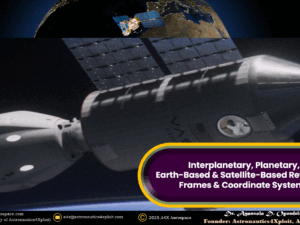

Satellite ground control stations, terrestrial facilities with antennas used for establishing line-of-sight communication with satellites, transmitting uplink signals, and receiving downlink signals, are essential for monitoring satellite health status and downloading valuable data. They are strategically located around the world to provide continuous connectivity with satellites as they orbit Earth.
In determining the classical orbital elements of space objects, satellite ground control stations play crucial roles. In addition, they gather raw data from a satellite and feed it into orbit determination algorithms to calculate the classical orbital elements and define the satellite’s exact orbit.
The concept of classical orbital elements, a set of six parameters that define an orbit around a central body, and known as Keplerian elements, is important for the prediction and understanding of the spacecraft and celestial body motion. In the years 1601 and 1619, Johannes Kepler built upon Tycho Brahe’s data to develop his three laws of planetary motion.
The Scientific Renaissance era resulted in Isaac Newton’s 1687 publication of his laws of motion and universal gravitation in Principia.
This course laid the foundation for the description and development of Keplerian orbital elements, which describe the shape, size, and orientation of an orbit, the importance of radar stations in determining spacecraft and celestial body orbital elements, and Kepler’s and Barker’s equations.
This course is divided into seven modules: Module 1: Radar Stations & Classical Orbital Elements, Module 2: Time Since Periapsis & Special Case of Circular Orbit, Module 3: Kepler’s Equation for Elliptical Motion, Module 4: Baker’s Equation for Parabolic Motion, Module 5: Kepler’s Equation for Hyperbolic Motion, Module 6: Example questions, and Module 7: Exercises.
a) Module 1: Radar Stations & Classical Orbital Elements:
b) Module 2: Time Since Periapsis & Special Case of Circular Orbit:
c) Module 3: Kepler’s Equation for Elliptical Motion:
d) Module 4: Baker’s Equation for Parabolic Motion:
e) Module 5: Kepler’s Equation for Hyperbolic Motion:
f) Module 6: Example questions:
g) Module 7: Exercises:
In this module, you will learn about:

Module 1 Section 1: Radar Stations
Module 1 Section 2: Classical Orbital Elements
Module 1 Section 3: Determination of Orbital Elements from Position & Velocity Vectors
Module 1 Section 4: Determination of Position & Velocity Vectors from Orbital Elements

Module 2 Section 1: Time Since Periapsis & Its Applications
Module 2 Section 2: Development of Time Since Periapsis Equation
Module 2 Section 3: Special Case of Circular Orbit
Module 3 Section 1: Elliptical Orbit Kepler’s Equation
Module 3 Section 2: Newton-Raphson Kepler’s Equation Root Finding Method
Module 3 Section 3: Practical Implication of The Elliptical Kepler’s Equation
Module 5 Section 1: Kepler’s Equation for the Case of a Hyperbolic Trajectory
Module 5 Section 2: Newton’s Method for Solving Hyperbola Kepler Equation
Module 5 Section 3: Application of Hyperbolic Kepler’s Equation
Module 6 Section 1: Example Question 1
Module 6 Section 2: Example Question 2
Module 6 Section 3: Example Question 3
Module 6 Section 4: Example Question 4